Price-led growth is now visible in India's FMCG numbers: in rural India, sales value rose 2.7% in January to March 2026 while volumes fell 0.8%, because prices rose 3.5%, according to NIQ. The same gap shows in traditional trade, where value rose 1.3% even as volumes fell 1.7%.
What NIQ's data shows about price-led growth
NIQ's India FMCG Quarterly Snapshot for Q1 2026, published on 25 May, covers offline sales through general and modern trade. Across India, value grew 3.0%, volume 0.9% and price 2.1%. The split matters more than the total. Urban markets grew volumes 2.2% with only 1.0% price growth. Rural markets went the other way, with price doing all the work.
Channels show the same divide. Traditional trade, which NIQ says carries 89% of offline FMCG sales, lost volume while value crept up on 3.0% price growth. Modern trade grew volume 22.7% while its prices fell 4.3%. Over-the-counter (OTC) products had the widest gap, with value up 2.2% on volume down 2.4% and price up 4.7%.
NIQ also says overall price growth fell to its lowest level in six quarters while average pack sizes improved. So this is not a story of runaway inflation. It is a story of where volume is missing: rural shoppers and the kirana counter.
How HUL and Tata Consumer split price and volume
Company results for July to September show price and volume pulling differently by category. Hindustan Unilever reported 15% underlying sales growth on 28 October with underlying volume growth of 7%, so less than half its growth came from volume. Its Foods segment grew 9% with only low-single-digit volume growth, while Home Care grew 22%, led by double-digit volumes and what HUL called "calibrated pricing actions".
A quarter earlier, on the June quarter earnings call, HUL said its 10% growth was "driven equally by volume and price", and that Personal Care's 4% growth came from price increases taken in response to palm oil inflation for a second year.
Tata Consumer Products shows the reverse case in tea. On 26 October it said India tea volumes were flat amid subdued category demand, and revenue declined marginally "as the volume-value gap narrowed following pricing actions". Salt, by contrast, grew revenue 15%, and Tata Consumer's investor presentation says salt volume growth stayed strong at 9% despite the price increase. Its India branded business posted 11% underlying volume growth overall. We covered the full quarter in Tata Consumer Q2 profit rises 16 percent to ₹470 crore.
Why price-led growth is fragile at the ₹5 and ₹10 shelf
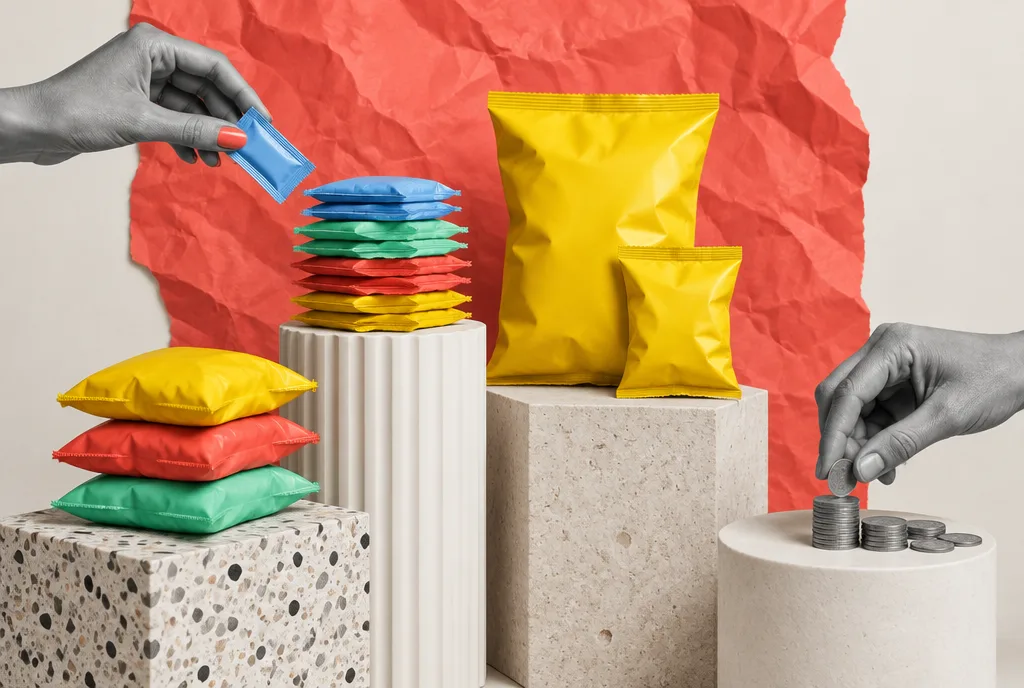
NIQ's deck names the pressure point. It says inflation "is breaking the magic price point model" in rural India, where categories such as biscuits, salty snacks and detergent bars lean heavily on ₹5 and ₹10 packs. Under cost pressure, companies are rationalising assortments and adjusting pack sizes, and NIQ says the traditional affordability-led growth model is weakening.
That explains why value can rise while volume stalls. A fixed-price pack cannot absorb a cost increase without a smaller grammage or a new price point, and either change can cost buyers at the counter. NIQ adds that small and mid-sized manufacturers, more dependent on rural and traditional trade, are slowing more sharply than large players.
For category managers, the read-across is to track volume and price separately by channel and town class, not just the headline value line. Rural demand behaves differently from metro demand, a point we made in why Bharat is not a single consumer segment.
Questions this story answers
What is price-led growth in FMCG?
Price-led growth is when sales value rises mainly because prices went up, not because shoppers bought more units. NIQ's Q1 2026 data shows this in rural India, where value rose 2.7% while volume fell 0.8% on 3.5% price growth.
Which channels show volumes falling while value rises?
NIQ says traditional trade, which carries 89% of offline FMCG sales, lost 1.7% in volume in January to March 2026 while value rose 1.3% on 3.0% price growth. Modern trade grew volume 22.7% while its prices fell 4.3%.
How did HUL's growth split between price and volume?
HUL reported 15% underlying sales growth and 7% underlying volume growth for July to September 2026, so less than half came from volume. Its Foods segment grew 9% with low-single-digit volume growth, while Home Care was led by double-digit volumes.