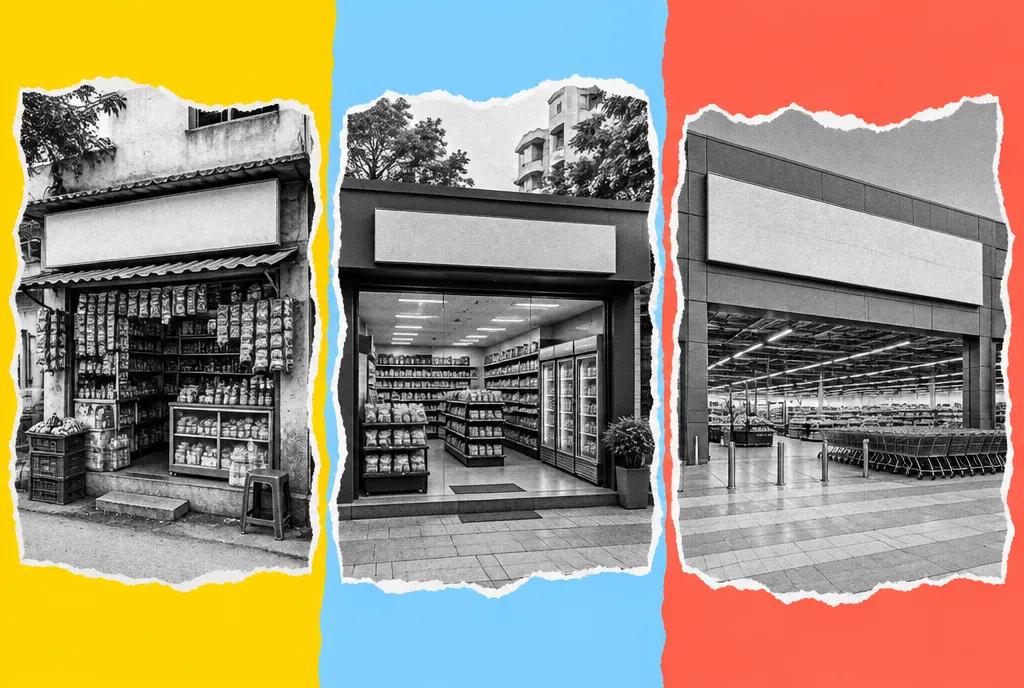
Many Indian retail chains now run more than one store format, and several are testing new retail formats alongside their standard box. Express stores, neighbourhood outlets, hybrid sites that also fulfil online orders and larger destination stores each answer a different question. Underneath them sits the same test: which box produces the best return on the capital and management attention it consumes.
What new retail formats are trying to solve
Convenience and express stores trade breadth for proximity. They carry a narrow assortment of high-frequency items in a small footprint near homes or offices. Their appeal is lower rent per site and quick top-up shopping, which competes directly with quick commerce and the kirana store. Their weakness is basket size: small visits generate small tickets, so labour and rent must be tightly controlled.
Neighbourhood formats sit between express and the standard store. They aim to capture a household's regular grocery or apparel shopping within walking or short driving distance. Success depends on reading local demand closely, since the assortment cannot cover everything.
Larger formats rely on choice and destination appeal. They need a wide catchment, parking or transit access and strong weekend traffic. They can carry higher-margin categories and services, but they also carry the highest rent and fit-out bill.
Hybrid stores combine walk-in trade with online fulfilment, using back-of-store space to pick orders. They test whether one site can earn from two channels without either suffering.
How to judge a format trial
A format is an economic model, so comparisons should be made per square foot and per unit of capital, not per store. The relevant measures include sales density, gross margin after shrinkage, staff hours per transaction, stock turns and the time taken to recover the initial investment. Average ticket size and visit frequency explain the mix: a small store with frequent visits can match a large one with occasional trips.
Execution is the second test. A format that works in a handful of stores managed by an experienced team may not hold up across dozens. Supply chain matters here: small stores need frequent, smaller replenishment drops, which raises distribution cost per unit unless stores are clustered.
What to watch
The signal is not the launch but the rollout. Chains tend to announce trials loudly and scale quietly. A format that moves from pilot to dozens of sites has passed internal tests. One that stays at a handful of locations, or whose stores are converted back to the standard format, has not.
The decision that matters for each chain is capital allocation. Every new format competes with the core store for sites, people and money. The formats that survive will be those that earn more per unit of capital than the format they sit beside, not those that attract the most attention at launch.
Questions this story answers
What new store formats are Indian retail chains testing?
Chains are testing convenience and express stores, neighbourhood formats, larger destination stores and hybrid stores that combine walk-in trade with online fulfilment. Each answers a different question, from quick top-up shopping near homes to choice and destination appeal across a wide catchment.
How should a retailer judge a new store format trial?
Compare formats per square foot and per unit of capital, not per store. Relevant measures include sales density, gross margin after shrinkage, staff hours per transaction, stock turns and time to recover the initial investment, with average ticket size and visit frequency explaining the mix.
Why do small store formats struggle to scale?
A format that works in a handful of stores run by an experienced team may not hold up across dozens. Small stores need frequent, smaller replenishment drops, which raises distribution cost per unit unless stores are clustered, and small baskets leave little room on labour and rent.