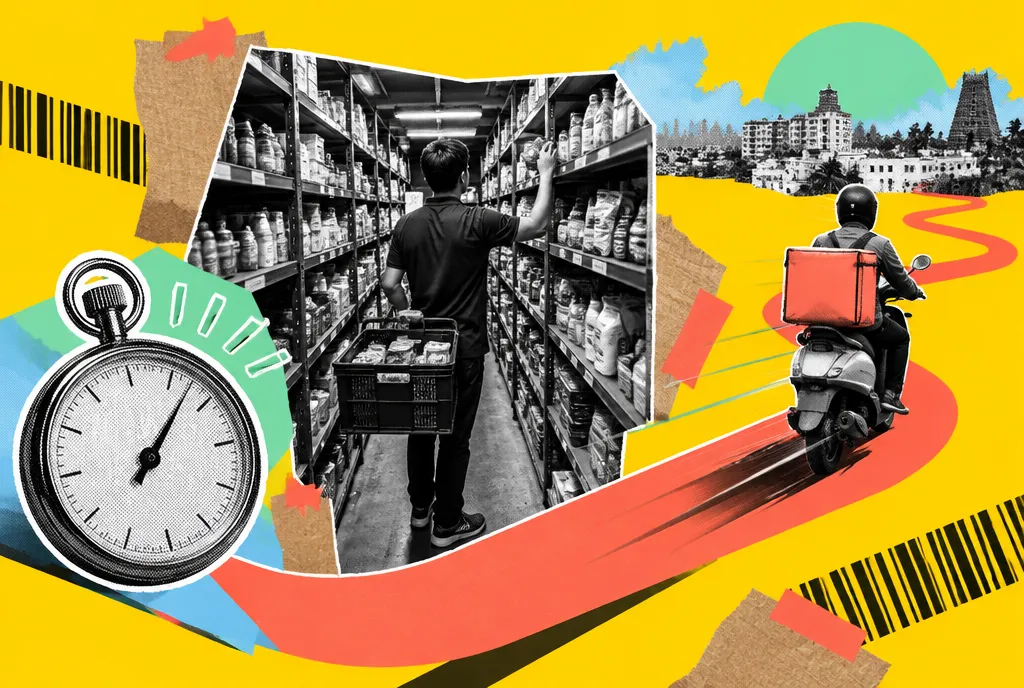
Quick commerce promises delivery within minutes. That promise rests on dark stores: small local warehouses positioned close to customers, each holding a limited range. Space is the binding constraint, and it is reshaping what brands make, how they pack it and how they negotiate for shelf room.
Every slot has to earn its place
A dark store holds far fewer products than a large supermarket. Each item competes for a slot, and platforms judge slots by sales velocity, margin and how often a product appears in orders. Slow sellers are delisted or moved to a longer delivery promise. The result is an assortment that is wide across categories but shallow within each one, with depth reserved for the fastest movers.
This favours brands with strong consumer pull and penalises long-tail variants. A brand with many flavours or sizes may find only its best-sellers stocked. Niche and regional products face a harder entry unless they sell quickly in a specific locality.
Pack sizes and product design
Quick commerce baskets tend to be smaller and more immediate than planned monthly grocery trips. Shoppers order what they need for the day or the evening. Brands have responded in several ways:
- Smaller and single-serve packs suited to immediate consumption.
- Combination packs that bundle related items into one slot.
- Packaging redesigned for fast picking and compact storage rather than shelf display.
- Products launched online first to test demand before wider distribution.
Pack sizes designed for quick commerce can carry a higher price per unit, which suits platform and brand margins but may affect how shoppers judge value.
Quick commerce replenishment and negotiation
Small stores need frequent replenishment. Brands and distributors must deliver smaller quantities more often, sometimes to many locations across a city. That raises supply chain costs and requires accurate demand data at the level of each dark store.
Platforms use their control of scarce space in negotiations. Brands may pay for visibility through in-app placements, accept margin terms or fund promotions to secure or keep a slot. The arrangement looks more like modern trade than traditional e-commerce, with the platform acting as both retailer and media owner.
For traditional retail the shift has knock-on effects. Kirana stores and supermarkets lose some top-up purchases, and brands must manage distinct pack architectures and price points for different channels.
The evidence lies in assortment data over time: how many products per category platforms carry, how often they rotate and which brands gain or lose slots. On the brand side, the measures are sell-through per dark store and the incremental cost of serving the channel.
The open question for brands is whether quick commerce creates new consumption or redirects existing sales at a higher cost to serve. The answer will determine how much product development and trade spending the channel deserves.
Questions this story answers
How do quick commerce platforms decide which products to stock?
Each product competes for a limited slot in a dark store, and platforms judge slots by sales velocity, margin and how often the product appears in orders. Slow sellers are delisted or moved to a longer delivery promise, leaving depth for the fastest movers.
Why are brands launching smaller packs for quick commerce?
Quick commerce baskets tend to be smaller and more immediate than monthly grocery trips, as shoppers order what they need for the day. Smaller, single-serve and combination packs suit that, and can carry a higher price per unit, which may affect how shoppers judge value.
How does quick commerce affect kirana stores and supermarkets?
Kirana stores and supermarkets lose some top-up purchases to quick commerce. Brands must also manage distinct pack architectures and price points for different channels, adding complexity to how they supply traditional retail alongside dark stores.